In This Guide
The best glute exercises for women at home are bridges, step-ups, lunges, squats and leg lifts done slowly and with control. You need no equipment, just a mat, a sturdy stair and 20 minutes, two or three times a week. Below are eight moves, a ready routine and a 4-week plan to make them harder as you get stronger.
Most of us sit for hours, at a desk, in the car or on the sofa. Your glutes do very little while you sit. Over time they can feel weak, and you may notice more strain in your lower back or knees when you climb stairs or lift something heavy.
Strong glutes help with all of that, and they also give a firmer, more lifted shape. For a full-body routine, see our full-body home exercises.
You have three glute muscles on each side:
A good routine works all three, so it needs both "push back" moves (bridges, lunges) and "side" moves (leg lifts, clamshells).
Do each move slowly: about 2 seconds up and 2 seconds down, with a short squeeze at the top.
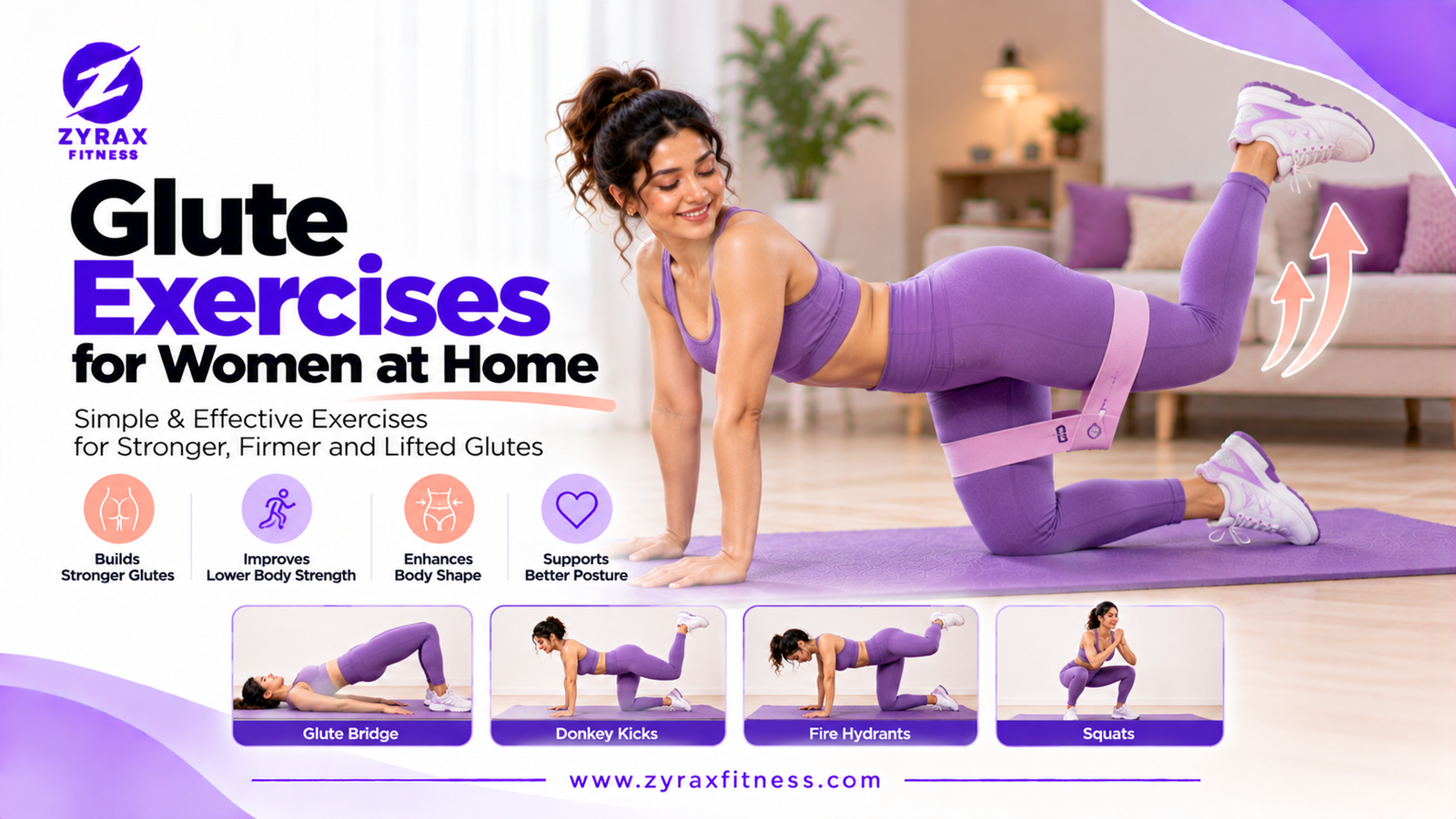
Lie on your back, knees bent, feet flat and hip-width apart. Press through your heels and lift your hips until your body makes a straight line from shoulders to knees. Squeeze your glutes, hold for 2 seconds, then lower. Tip: if you feel it in your hamstrings, move your feet a little closer to your hips.
The same as above, with one foot lifted off the floor. It is much harder, so start with 6–8 per side.
Stand facing the bottom stair or a sturdy, non-slip step. Place your whole right foot on it, push through the heel and stand up tall, then step down slowly. Do all reps on one side before switching. Holding a filled water bottle in each hand makes it harder.
From standing, step your right foot back and lower until both knees bend to about 90 degrees. Push through the front heel to return. A slight forward lean of the chest puts more work on the glutes.
Stand with your feet wider than your hips and toes turned slightly out. Sit back and down, keeping your knees in line with your toes, then press up and squeeze at the top.
Kneel on all fours. Keeping your knee bent, lift one foot up towards the ceiling until your thigh is in line with your back. Don't arch your lower back; keep your belly gently tight.
Lie on your side with your legs straight and stacked. Lift the top leg about 30–40 cm, toes pointing slightly down, then lower slowly. You should feel this on the side of your hip.
Lie on your side with your knees bent and feet together. Keeping your feet touching, open your top knee like a clamshell, then close it. Do not roll your hips backwards.
A 2020 systematic review in the Journal of Sports Science and Medicine compared gluteus maximus activity across common strength exercises. Step-up and hip-thrust/bridge-style movements were among those with the highest activation, and lunges and squats also worked the muscle well (Neto et al., 2020). That is why step-ups and bridges anchor the routine below.
| Block | Exercise | Sets × Reps | Rest |
|---|---|---|---|
| Warm-up (3 min) | March on the spot, hip circles, 10 bodyweight squats | — | — |
| Main | Glute bridge | 3 × 15 | 30 sec |
| Main | Step-up | 3 × 10 per leg | 45 sec |
| Main | Reverse lunge | 3 × 10 per leg | 45 sec |
| Main | Sumo squat | 2 × 15 | 30 sec |
| Finisher | Donkey kick + side-lying leg raise + clamshell | 2 rounds × 12 each, per side | 30 sec |
| Cool-down (2 min) | Figure-4 stretch, child's pose | — | — |
Do this 2–3 times a week on non-consecutive days. The WHO recommends muscle-strengthening activity on at least two days a week for adults (WHO, 2020).
| Week | What Changes |
|---|---|
| 1 | Learn the form. 2 sets of each move, slow and controlled |
| 2 | Full routine: 3 sets as in the table |
| 3 | Swap the glute bridge for the single-leg bridge; add a 3-second pause at the top of each step-up |
| 4 | Hold water bottles or a backpack with books for step-ups and lunges; add 2 reps to every set |
When 15 reps feel easy, make the move harder (slower, one leg, or more weight) rather than just doing more reps.
Stop if any move causes sharp pain, especially in the knee or lower back. If you have a current knee problem, start with bridges, clamshells and leg raises, and read our guide to Zumba with knee pain. If you are pregnant or have recently given birth, check with your doctor first.
You don't need a gym to build strong glutes. Eight moves, a stair, 20 minutes and a simple 4-week plan are enough to start. Keep the reps slow, add difficulty every week, and pair the routine with cardio and enough protein — see how much protein you need — for the best results.
Want to work your glutes with music and a trainer watching your form? Join our live online Zumba classes. Toning songs include lunges, squats and kicks. Start with the ₹99 two-day trial.
Most women feel stronger within 3–4 weeks of training two or three times a week. Visible changes in shape usually take longer and depend on food, sleep and consistency.
It is better not to. Muscles grow during rest, so train them 2–3 times a week with a day off in between. Light walking or Zumba on the other days is fine.
Squats help, but adding bridges, step-ups and side leg lifts works all three glute muscles more completely.
Bodyweight training builds firm muscle slowly. It tends to make the area look lifted and toned rather than bulky.
Weak glutes are often linked with lower-back strain. Gentle bridges can help many people, but see a doctor or physiotherapist about ongoing pain. Our guide on lower back pain in women explains more.
References: Neto WK et al. (2020), Gluteus maximus activation during common strength and hypertrophy exercises: a systematic review, J Sports Sci Med · WHO guidelines on physical activity and sedentary behaviour (2020)
Key Takeaways
Ready To Begin?
Join Zyrax Fitness's live online Zumba and yoga classes and make your fitness journey fun again.
Start Your Journey