In This Guide
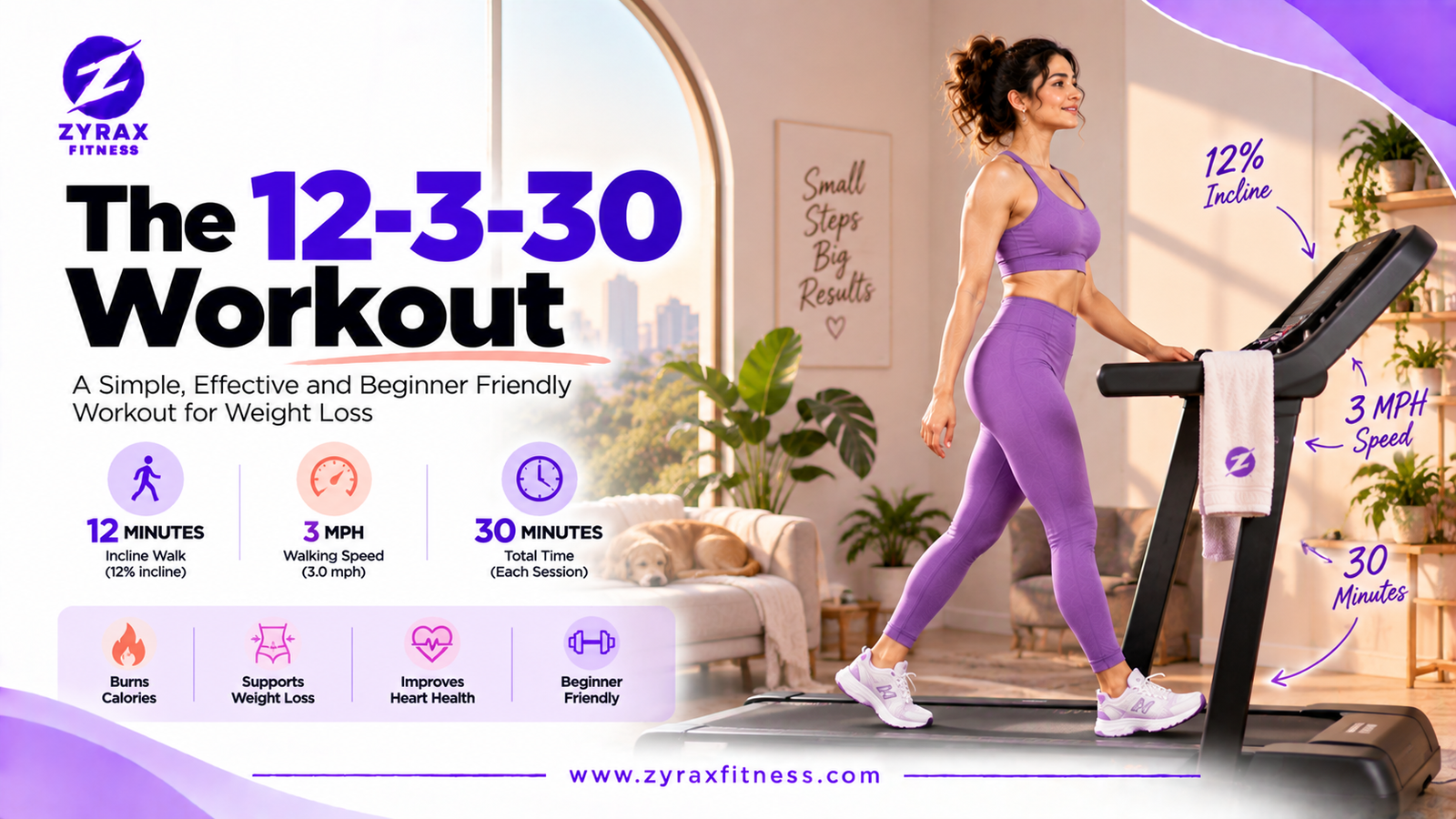
The 12-3-30 workout means walking on a treadmill at a 12% incline, at 3 miles per hour (about 4.8 km/h), for 30 minutes. It is a demanding but low-impact cardio session. A 2025 study found it burned about as many calories as a self-paced run, but took longer to do. If you don't have a treadmill, you can get a similar steady, uphill-style effort at home with stairs and a step.
The workout went viral on social media because it looks simple: no running, no jumping, just walking uphill. But is it worth your 30 minutes, and is it right for you?
Walking uphill makes your legs lift your body weight upwards with every step. Your heart and lungs have to work much harder than on flat ground, even at a slow walking pace. Your glutes, hamstrings and calves also do more work, while your joints avoid the pounding of running.
The American College of Sports Medicine's walking equation gives an idea of the effort. Walking at 3 mph on a 12% grade comes to roughly 8 METs, which counts as vigorous activity (anything above 6 METs is vigorous). For a 60 kg woman, that is roughly 240–250 kcal in 30 minutes. This is an estimate. Your real number depends on your weight, fitness and whether you hold the handrails.
In a small study at the University of Nevada, Las Vegas, 14 regularly active adults (5 women, 9 men, average age 25) did two sessions (Wong et al., 2025, International Journal of Exercise Science):
| Measure | 12-3-30 Walk | Self-Paced Run (Same Calories) |
|---|---|---|
| Time taken | 30.1 min | 23.9 min |
| Calories burned | 308 kcal | 310 kcal |
| Calories per minute | 10.2 | 13.1 |
| Share of energy from fat | 41% | 33% |
What this means in plain words:
So 12-3-30 is a solid cardio option, especially if you can't or don't want to run. It is not a magic fat-loss formula.
Holding the handrails makes it easier, because your arms take some of your weight. Let go once you can keep your balance.
Most Indian homes don't have a treadmill, but most have stairs or a sturdy step. This routine aims for the same feel: steady, uphill-style effort where you can talk in short sentences but not sing. It is not an exact copy of the treadmill numbers.
| Minutes | What to Do |
|---|---|
| 0–3 | Warm-up: march on the spot, arm swings |
| 3–6 | Step-ups on the bottom stair, alternating the lead leg every 10 steps |
| 6–8 | High-knee march in place |
| 8–26 | Repeat the step-up + march blocks: 3 min step-ups, 2 min march (about 4 rounds) |
| 26–30 | Cool-down: slow march, calf and hamstring stretch |
Options:
Step-ups also work your glutes hard; for more, see our glute exercises at home.
Two to three sessions a week is a good start, alongside two strength sessions. The WHO recommends 150–300 minutes of moderate or 75–150 minutes of vigorous activity a week (WHO, 2020). Three 12-3-30 sessions add up to 90 minutes of mostly vigorous work. Short on time? See how to stay fit with 30 minutes a day.
The 12-3-30 workout is a tough, low-impact cardio session that burns about as many calories as a run, just more slowly. It suits women who want joint-friendly cardio, but beginners should scale it down. And no treadmill is needed to get similar steady uphill effort at home.
Prefer music to a treadmill? Our live online Zumba classes give you 30–45 minutes of steady cardio from your living room. Try them with the ₹99 two-day trial.
It can help as part of a calorie deficit. In the UNLV study it burned about 300 kcal per session, similar to an equal-calorie run. Food matters more for weight loss than any single workout.
Not better, just different. Running burns calories faster; 12-3-30 is gentler on the joints and easier for people who don't run.
Yes, but scale it. Start with a lower incline (5–8%) and 15–20 minutes, and add 1–2% or 5 minutes each week.
Only for balance at first. Leaning on them reduces the effort and can strain your back and shoulders.
Your calves and Achilles need recovery. Alternate it with Zumba, yoga or strength days.
References: Wong MWH et al. (2025), An exploratory study comparing the metabolic responses between the 12-3-30 treadmill workout and self-paced treadmill running, Int J Exerc Sci 18(6):56–64 · WHO guidelines on physical activity (2020) · MET estimate from the ACSM walking equation (VO₂ = 0.1×speed + 1.8×speed×grade + 3.5).
Key Takeaways
Ready To Begin?
Join Zyrax Fitness's live online Zumba and yoga classes and make your fitness journey fun again.
Start Your Journey