In This Guide
Period cramps are so common that many of us are told to put up with them. Research now suggests that regular exercise may take the edge off for many women, but only if you do it consistently and know when cramps are a sign of something else. Here is what the studies found, what a realistic routine looks like, and the warning signs that mean it is time to see a doctor.
Quick answer: Reviews of randomised trials found that women who followed an exercise programme for about 8 weeks reported lower period pain than women who did not. The studies are mostly small, so exercise is best treated as a helpful addition, not a guaranteed fix.
Doctors call painful periods dysmenorrhea. Primary dysmenorrhea is cramping without an underlying pelvic condition. It usually starts within 6 to 12 months of a girl's first period, tends to peak as bleeding begins, and may come with nausea, loose stools or headache, according to a 2025 meta-analysis. That review also notes that reported prevalence ranges widely, from 24% to 92% depending on the population studied.
Secondary dysmenorrhea is pain caused by another condition, such as endometriosis or fibroids. That matters because the advice below is mainly for primary cramps. If your pain is new, worsening or severe, jump to the section on when to see a doctor.
The honest summary: the pattern is consistent, the trial quality is modest, and no exercise type has been proven best. The best routine is the one you will actually keep doing.
Researchers think the benefit may come from endorphins and lower inflammation, but that is still being studied.
The trials used structured programmes, so a steady schedule matters more than intensity. Build up gradually and keep it comfortable.
| Weeks | Sessions | Each Session |
|---|---|---|
| 1 to 2 | 3 a week, 15 to 20 minutes | 5 minutes brisk walking or gentle dance steps, 10 minutes stretching and yoga, 5 minutes slow breathing |
| 3 to 4 | 3 a week, 25 to 30 minutes | 10 minutes low-impact cardio, 10 minutes yoga or light strength, 5 to 10 minutes relaxation |
| 5 to 8 | 3 to 4 a week, 30 minutes or more | 10 to 15 minutes cardio, 10 minutes strength or yoga, 5 to 10 minutes relaxation. Aim for 90 minutes a week in total. |
You do not need to train through pain. On the worst day, try slow breathing, a few gentle stretches or a short walk, and use a warm compress on your lower abdomen if that helps. Rest if you need to. Consistency across the month matters more than any single session. If you feel tired and dizzy because your periods are heavy, check iron first and read exercise with anaemia.
See a doctor if:
These can point to conditions such as endometriosis (see our guide to exercise with endometriosis), fibroids or infection, which need a medical assessment. Your doctor may suggest pain relief or hormonal options; take any medicine only as advised and as the label directs.
Live online sessions give you a schedule, which is exactly what the trials had. Zyrax runs online yoga and online Zumba for women, and you can pick lower-intensity options around your period. If you are unsure whether to train on a particular day, our guide to training around your cycle explains what the evidence does and does not support.
If your cramps are the usual kind, a steady routine of walking, gentle yoga, strength work and relaxation is a low-risk way to try for relief, and the research gives you a clear target: about 30 minutes, three times a week, for eight weeks. If they are not the usual kind, get them checked. To make the routine easier to follow, message the Zyrax team on WhatsApp and we will help you choose an online yoga or Zumba class that fits your schedule.
Trials suggest it can reduce pain after about 8 weeks of regular exercise, though the evidence is modest and results vary.
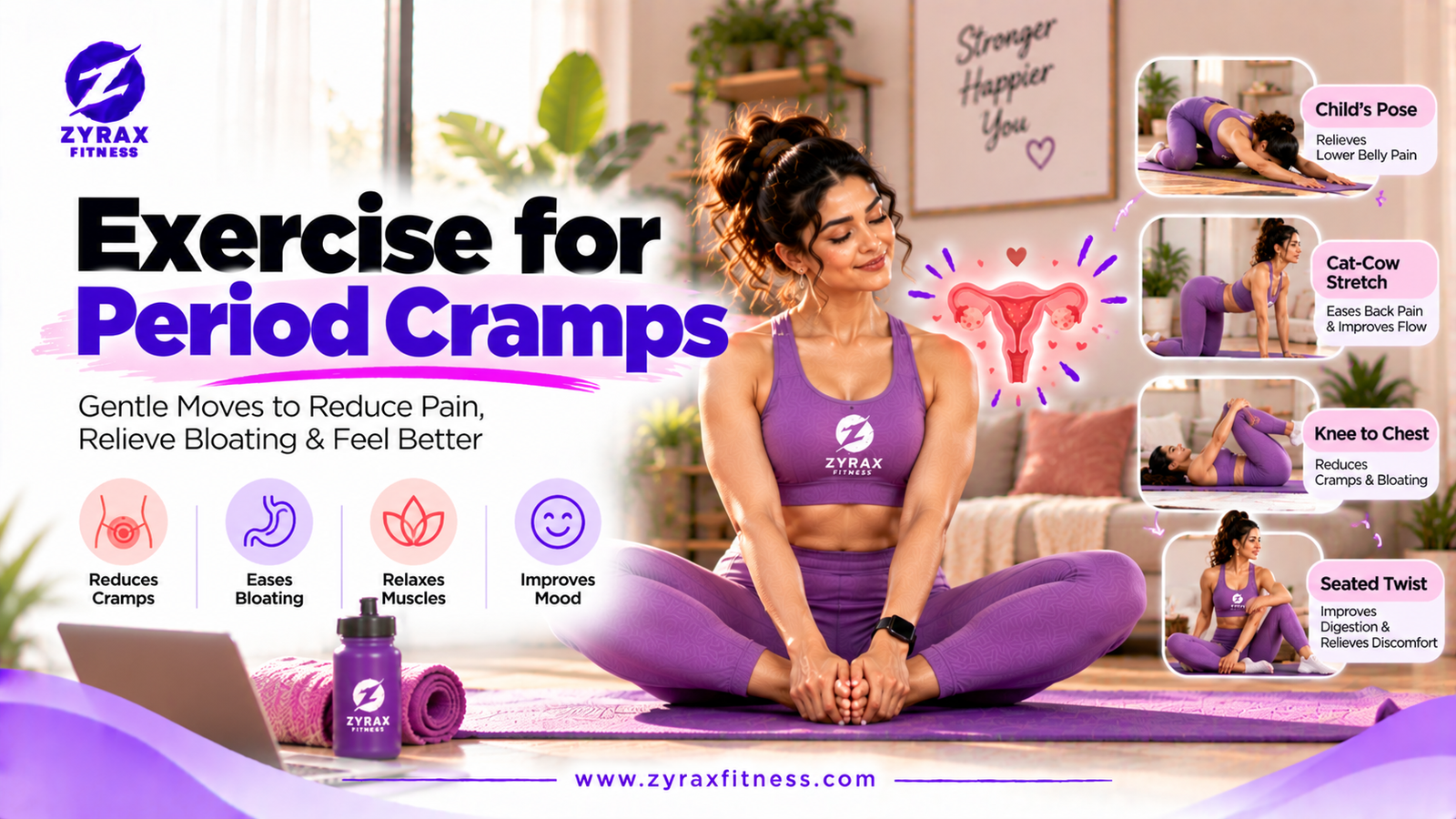
Child's pose, cat-cow, butterfly pose, a gentle reclined twist and legs up the wall are commonly used. No single pose has been proven better than another.
Only if you feel up to it. Light walking, stretching or breathing is fine for many women. Rest is also fine.
There are no trials of Zumba specifically. It is aerobic exercise, which was among the types that reduced cramp pain, so a low-impact class can be reasonable if you feel well.
The trials measured results at 4 and 8 weeks. Some women feel a comfort effect sooner, but plan for about two months of regular activity.
Cramps are common, but pain that is severe, getting worse or interfering with daily life should be checked by a doctor.
References: Tsai IC et al. Comparative effectiveness of different exercises for reducing pain intensity in primary dysmenorrhea: network meta-analysis. Sports Medicine - Open, 2024 · Xiang Y et al. Efficacy and safety of therapeutic exercise for primary dysmenorrhea. Frontiers in Medicine, 2025 · Physical activity for primary dysmenorrhea: systematic review and meta-analysis. American Journal of Obstetrics and Gynecology, 2018 · Therapeutic exercise in the treatment of primary dysmenorrhea. Physical Therapy, 2019
Key Takeaways
Ready To Begin?
Join Zyrax Fitness's live online Zumba and yoga classes and make your fitness journey fun again.
Start Your Journey