In This Guide
To prevent osteopenia and osteoporosis after age 35, women need:
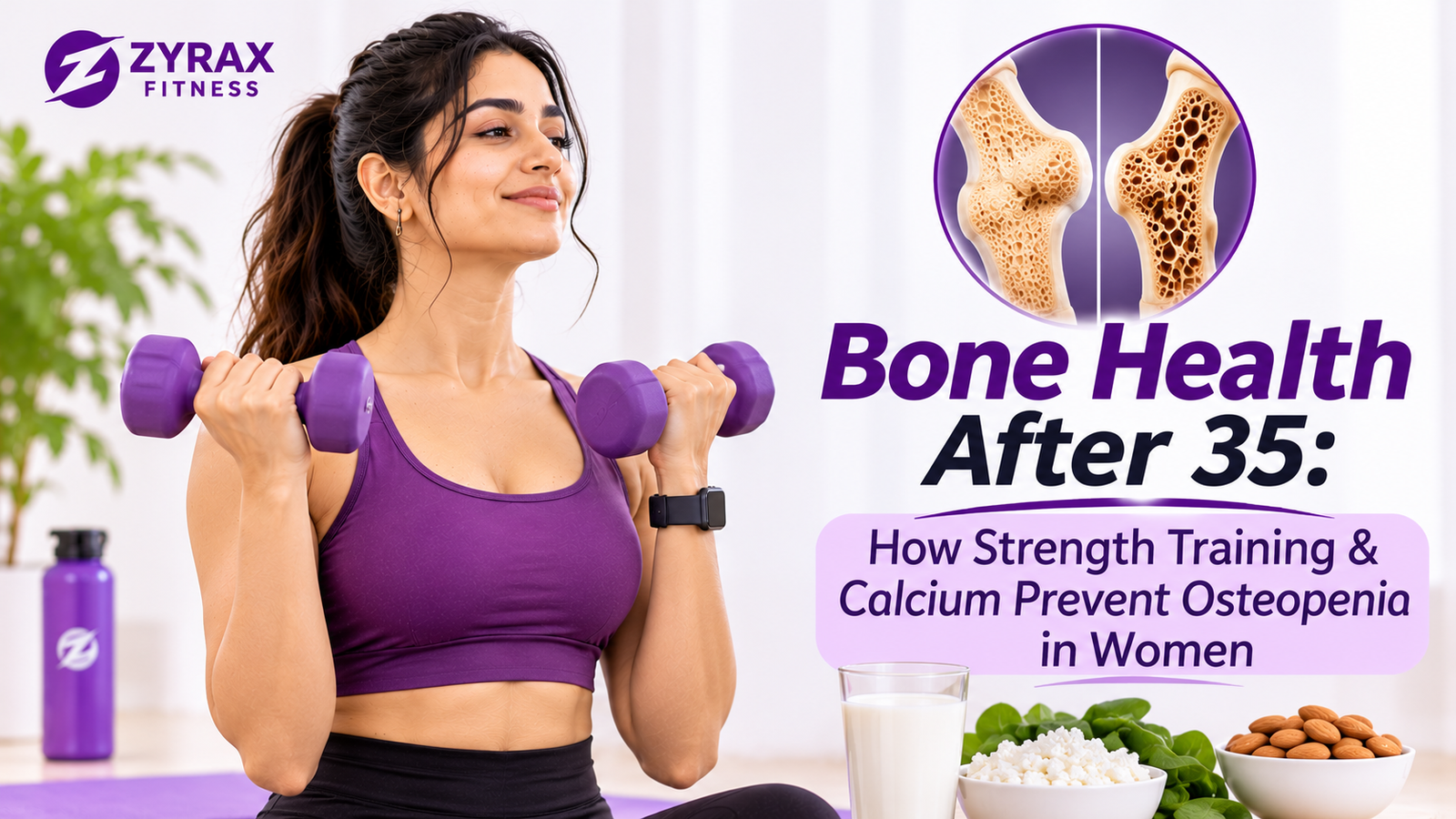
Mechanical loading from lifting weights pulls on bone tissue, stimulating bone-building cells (osteoblasts) to increase mineral density in the hips, spine, and wrists.
This guide is general information. If you have osteopenia, osteoporosis, a past fracture or joint problems, ask your doctor before starting a new exercise plan or supplement.
Peak bone mass is typically achieved around age 25 to 30. After age 35, natural bone resorption gradually begins to outpace new bone formation, a process that accelerates sharply during perimenopause and menopause as protective estrogen declines.
Indian women face unique risk factors that often trigger osteopenia (early bone thinning) in their late 30s and 40s:
According to Wolff's Law, bones adapt to the physical loads placed upon them. When you perform resistance exercises (using dumbbells, kettlebells, resistance bands, or bodyweight impact), tendons pull on bone surfaces, creating micro-strains that signal osteoblasts to lay down fresh collagen and calcium-phosphate crystals.
New to weights? Our guide to choosing your first dumbbell weight helps you start safely.
Focus on multi-joint movements that load the lumbar spine, femoral neck (hips), and wrists, the three most common fracture sites in later life:
Loads the hips, femurs, and spine axially.
Strengthens the posterior chain while placing safe tensile load across the lumbar vertebrae and pelvis.
Builds bone density in the wrists, forearms, shoulders, and thoracic spine.
Single-leg loading strengthens hip joint stability and balance to prevent falls.
Provides direct compressive loading through the wrists and arms.
Short bouts of controlled impact (for example, 20 to 30 gentle heel drops or mini-hops, if your joints are healthy) deliver a strong bone-building stimulus to the lower limbs.
Want a full routine? Try our strength training plan for women at home or this home workout for women over 40.
Want guided strength and balance work?Our live online yoga classes build strength, posture and balance with a certified instructor who corrects your form in real time, so you train safely from home.
Book a Free TrialAim to spread 1,000 mg of calcium across 2 to 3 meals daily, as the body absorbs roughly 500 mg of calcium at one time.
| Indian Food Source | Serving Size | Approx. Calcium | Absorption Tip |
|---|---|---|---|
| Ragi (finger millet) | 100 g raw flour (about 2 rotis) | ~340 mg | Sprout or ferment ragi batter to reduce phytates and boost mineral uptake |
| Sesame seeds (til) | 2 tablespoons (20 g) | ~195 mg | Use unhulled white or black til in chutneys, laddoos, or salad toppings |
| Paneer / tofu (calcium-set) | 100 g | ~200-350 mg | Pair with vitamin D-rich meals for better absorption |
| Curd / Greek yogurt | 1 medium katori (150 g) | ~180-220 mg | Fermentation enhances calcium bioavailability and supports gut health |
| Amaranth leaves (chaulai) | 1 cup cooked | ~200 mg | Lightly sauté with garlic and lemon juice |
| Horse gram (kulthi dal) | 1 cup cooked | ~140 mg | Soak overnight before pressure cooking |
Taking calcium alone without its supporting nutrients can result in poor bone mineralization:
Brisk walking helps maintain baseline lower-body bone mass and improves heart health, but research consistently shows that progressive resistance training and multi-directional impact are needed to actively build bone mineral density in the hips and spine.
Yes. Supervised progressive strength training is one of the most effective non-drug interventions for osteopenia. Focus on neutral-spine mechanics during hinges and squats, and avoid extreme loaded spinal flexion (such as heavy rounded-back sit-ups).
Try to meet at least 600 to 700 mg of your daily calcium through whole foods first, and use a low-dose supplement (such as calcium citrate, which absorbs well with or without food) only to bridge the remaining gap, under medical guidance.
Key Takeaways
Ready To Begin?
Join Zyrax Fitness's live online Zumba and yoga classes and make your fitness journey fun again.
Start Your Journey